Harnessing the World: A Deep Dive into Flat Outline Flag Icons for Global Communication
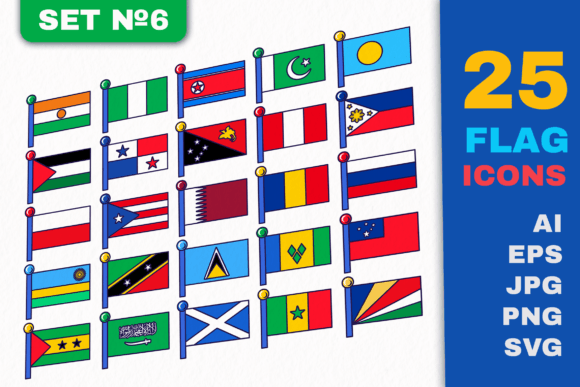
In a world where digital interfaces, marketing materials, and educational content demand clarity, speed, and universal recognition, the role of well-designed iconography is paramount. Among these visual tools, national flags stand as powerful, immediate symbols of geography, culture, and identity. The specific collection known as Flag Icons Set 9, particularly its component offering of 25 Flat Outline Flag Icons, provides a focused toolkit for representing a diverse array of nations with clean, modern aesthetics.
The Core Philosophy of Flat Outline Design
Flat outline icon design represents a deliberate departure from detailed, textured, or three-dimensional graphic styles. This approach emphasizes simplicity, using clear lines and shapes to define an object without fills, shadows, or gradients. For national flags, this methodology offers distinct advantages. It reduces visual clutter, ensuring the icon remains legible even at very small sizes, such as on mobile application buttons or social media avatars. The outline style inherently creates a neutral, versatile graphic that can be integrated into varied color schemes without clashing, as the icon itself is typically monochromatic or allows for easy color modification.
This design philosophy aligns with contemporary trends in UI/UX, where user interfaces prioritize clarity and speed of comprehension. A flat outline flag icon conveys its meaning instantly, without the cognitive load of interpreting complex artistic rendering. Furthermore, the "outline" nature often abstracts the flag into its most essential geometric components—stripes, stars, crosses, circles—making it recognizable even when stripped of its official colors. This abstraction is not a dilution of meaning but rather a distillation of its core symbolic form.
Strategic Selection: The 25 Nations in Focus
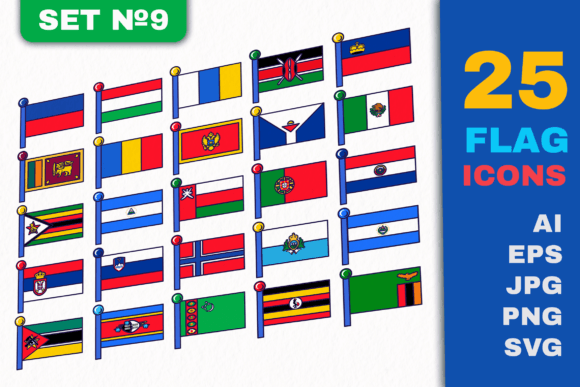
The curated list within this collection spans continents and represents a mix of prominent nations and lesser-represented territories, creating a balanced resource for many projects. From European nations like Hungary, Portugal, and the microstates of San Marino and Liechtenstein, to Asian countries such as Oman and Sri Lanka, African states including Kenya, Uganda, and Mozambique, and American countries from Mexico to Paraguay and Nicaragua, the selection is geographically thoughtful.
It also includes unique entities like Saint Martin, Svalbard og Jan Mayen, and the Canary Islands, which are crucial for projects dealing with specific regional tourism, logistics, or cultural studies. Including Swaziland (now officially Eswatini) and nations like Moldova, Montenegro, Serbia, and Slovenia speaks to an awareness of both historical and contemporary geopolitical landscapes. This variety ensures that a designer or content creator is not just equipped with flags for the world's largest economies, but also with symbols necessary for inclusive, detailed, or niche representations of the global community.
Practical Advantages of a Well-Structured Icon Set
Flag Icons Set 9 is not merely a folder of images; it is an organized digital asset. The provision of files in multiple formats—AI EPS 10 for vector editing, SVG for scalable web use, PNG with transparent backgrounds at five specific widths, and JPG for certain raster contexts—addresses the full spectrum of modern digital and print workflows. The vector nature (in AI and SVG files) is particularly critical. Vector graphics are mathematically defined, meaning they can be resized to any dimension—from a 128px shop tag to a 6000px wide banner—without any loss of quality or pixelation. This empowers users to adapt the icons for any output medium seamlessly.
The inclusion of five distinct PNG and JPG widths (128px, 256px, 512px, 1024px, 6000px) pre-optimizes the icons for common use-case scenarios. A 128px icon is ideal for web icon lists or mobile interfaces, 512px suits many presentation slides, and 6000px resolution meets the demands of high-quality print materials like posters or large format displays. This pre-sizing saves significant time, eliminating the need for manual resizing and ensuring consistency across a project's various asset sizes.
Real-World Applications and Use Cases
The utility of these flat outline flag icons extends across numerous professional and creative domains. In website design, they can be used for language selection dropdowns, indicating country-specific service pages, or showcasing international client portfolios. For applications, especially those related to travel, finance, or news, these icons serve as intuitive visual cues for filtering content by country or selecting a region.
Social media content creators can integrate them into posts, stories, or videos to highlight international events, celebrate global holidays, or promote worldwide campaigns. In educational and research contexts, such icons are valuable for creating clear maps, infographics illustrating demographic data, or presentations discussing international relations. Print templates for brochures, reports, or promotional materials benefit from the icons' clean lines, which remain sharp in lithographic printing.
Furthermore, their simplicity makes them perfect for interface design elements like buttons, badges, or status indicators. A business owner might use them on shop tags or labels to denote product origin. In video animation, the scalable vector formats allow for smooth zooming, rotation, and integration into motion graphics without quality degradation. The universal recognizability of flags, paired with a non-intrusive outline design, means they enhance comprehension without dominating the visual layout.
Technical Considerations and Workflow Integration
Working with such a collection requires an understanding of the different file formats. The AI EPS 10 file is the master editable source, ideal for users with Adobe Illustrator who may wish to ungroup elements, modify stroke weights, or combine icons into new composite graphics. The SVG files are essential for modern web development, as they can be styled directly with CSS—changing color, stroke width, or even adding animation via code—offering dynamic control within live websites.
The PNG files with transparency are the go-to choice for immediate placement in digital mockups, presentation software like PowerPoint or Keynote, and image editors for quick composites. The organized structure, presumably with clear naming conventions for countries and sizes, streamlines the asset management process. This organization is a key professional consideration, reducing project overhead and preventing the frustrating scenario of hunting through disorganized files for the correct version of an icon.
Beyond the Symbol: Cultural and Design Sensitivity
While these icons are graphic tools, using national flags carries a dimension of cultural respect. The flat outline design, by focusing on the official geometric configuration of each flag, helps maintain accuracy and avoids unintended stylistic interpretations that could alter a flag's recognized symbolism. When using these icons, especially for nations with rich historical and cultural identities like Portugal, Mexico, Kenya, or Zimbabwe, it is prudent to ensure the context of use is appropriate and respectful.
From a purely design perspective, the "easy to edit" vector characteristic allows for adaptation. A user might change the stroke color to match a brand palette—making a Paraguayan flag icon gold instead of black, for instance, to fit a luxury travel brand's theme. This flexibility must be balanced with the need to remain recognizable; drastic alterations could reduce the icon's effectiveness as a communicative symbol.
The collection’s inclusion of countries from every major continent and various political statuses makes it a tool for promoting inclusivity in visual communication. Projects aiming to showcase a truly global perspective can do so accurately, without resorting to generic "world globe" icons that lack specificity.
The Enduring Relevance of Geographic Iconography
As global interaction continues to increase through digital channels, the need for efficient, respectful, and visually coherent representations of nations grows. A dedicated set like the 25 Flat Outline Flag Icons within Flag Icons Set 9 meets this need by providing technically robust, aesthetically modern, and thoughtfully curated assets. It empowers professionals across fields—from developers and graphic designers to marketers, educators, and business owners—to integrate clear geographic signaling into their work.
The value lies not just in the individual icons, but in the cohesive system they form: scalable, editable, organized, and versatile. By prioritizing the essential form of each flag through outline design, the collection ensures that the symbol's communicative power is preserved and amplified, ready for integration into the next infographic, application update, social campaign, or international report that seeks to connect with a worldwide audience.